|
 |
RUS  |
|
About Laboratory | |
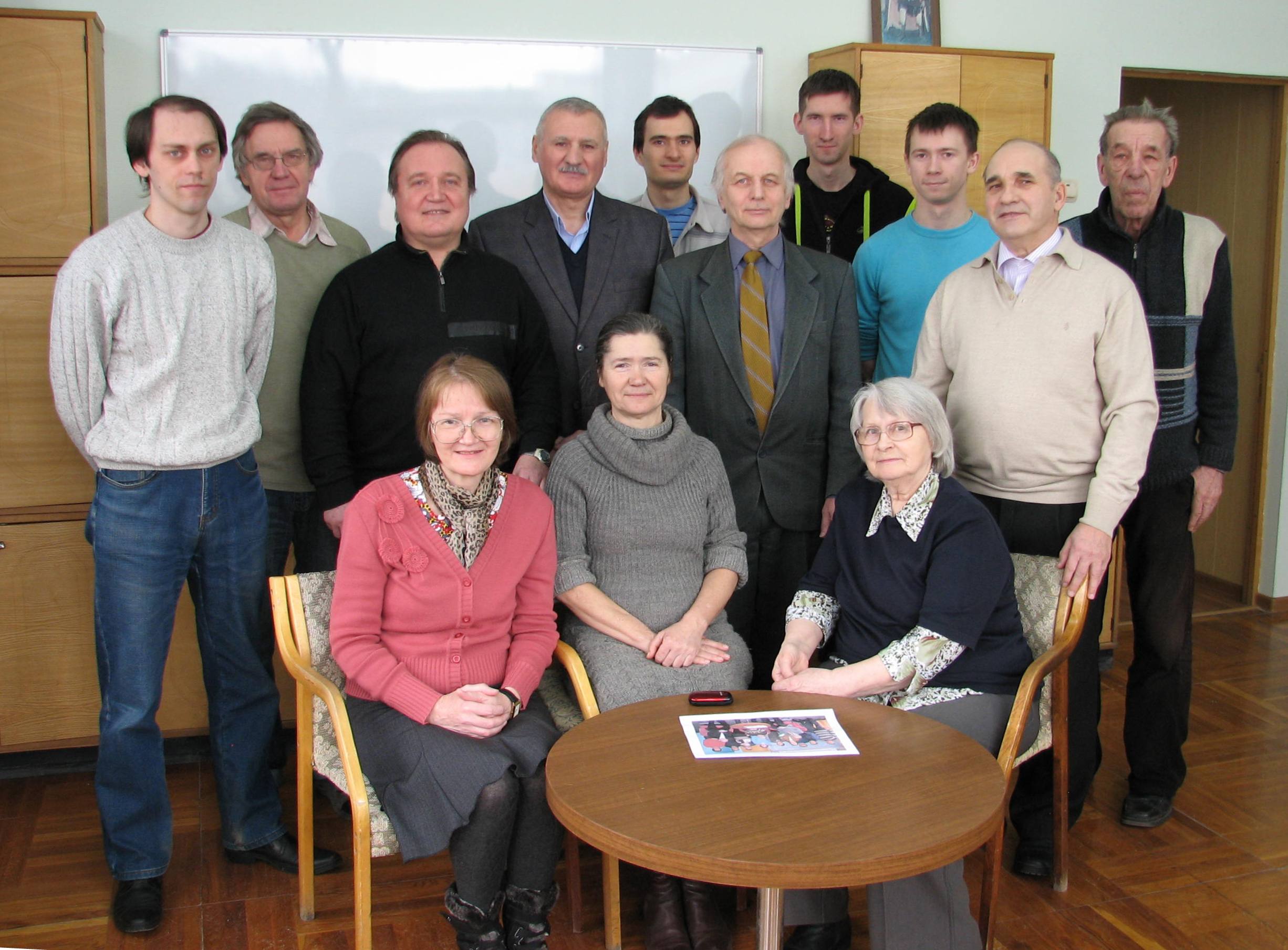
Staff | |
Publications | |
Grants | |
|
Experimental techniques High-pressures experiments are mostly aimed at studying phase transformations in solids, synthesising new phases and studying their composition, crystal and magnetic structure, physical and thermodynamical properties. The equipment used in these experiments is constructed and produced at ISSP and includes hydrostatic chambers operative at pressures to 2.5 GPa and temperatures to 800 K, a large variety of quasihydrostatic chambers operative to 9 GPa and 1500 K, and also diamond anvil cells specially designed for measuring the magnetic susceptibility of superconductors at pressures to 70 GPa and temperatures from 1.5 to 300 K. High-pressure cells used with the hydrostatic and quasihydrostatic chambers allow compressing the sample in various inert media and in a hydrogen atmosphere. In situ studies are carried out by the methods of resistometry, magnetometry, differential thermal analysis and piezometry. The technique also allows the rapid cooling of the synthesised samples under high pressure to liquid nitrogen temperature. At such a low temperature very many high-pressure phases are metastable at ambient pressure and can be removed from the high-pressure cell for further investigations by various methods. The maximum amount of a sample synthesized in one experiment is rather large on the scale of high-pressure physics and reaches 1000 (200) mm3 at pressures to 3 GPa and 200 (50) mm3 at pressures to 9 GPa if inert substance (hydrogen) is used as pressure transmitting medium. The specific feature of investigations at LHPP that distinguishes it from most other high-pressure laboratories is combining in situ measurements with studies at ambient pressure of new high-pressure phases fixed by quenching to liquid nitrogen temperature. To study the crystal and magnetic structures and lattice dynamics of the new quenched phases, neutron scattering techniques are widely used. Neutron experiments are mostly carried out with high-luminosity instruments at the Joint Institute for Nuclear Research in Dubna and at the Institute Laue-Langevin in Grenoble. The substances currently under research are various crystalline, nanocrystalline and amorphous metals and alloys and also carbon nanostructures. Among the recent scientific achievements: • Hydrogen in the a - MnH0.07 high-pressure phase is found to form an unusual sublattice and occupy positions arranged in dumb-bells 0.68 Å long. This distance being very small, it gives rise to anomalously strong effects of hydrogen tunnelling within the dumb-bells. In particular, the tunnelling splitting of the vibrational ground state of hydrogen atoms is as high as 6.4 meV and the hydrogen tunnelling therefore predominates over the thermal diffusion at temperatures up to 140 K. This is one of few quantum effects occurring at temperatures exceeding the liquid nitrogen temperature. Hydrogen tunnelling in metals has been studied for many years already, but the tunnelling splitting never exceeded 0.2 meV and the effect was observed only at temperatures below 10 K. • A reversible first-order phase transition between two different amorphous semiconductor phases, am1 and am2 , is found to occur in the Zn-Sb system at pressures around 1 GPa. The line of the am1 ↔ am2 metastable equilibrium is experimentally determined and shown to terminate at a critical point near 100°C. This is the first observation of phase equilibrium between amorphous semiconductor phases. • Structure investigations of Cu2O at high pressures showed that heating the sample at a pressure of 33 GPa results in the series of transformations: hexagonal phase of Cu2O → amorphous state → decomposition to crystalline Cu and CuO. This provides the first experimental evidence that not only the solid-state amorphization can be an intermediate stage of a polymorphous transformation, but it can also be a mid-stage of chemical destruction of solids. • An investigation and comparative analysis of high-pressure phase diagrams of the Mo-D and Mo-H systems have for the first time given experimental evidence that the line of hydride decomposition is close to the equilibrium line, while the line of hydride formation is significantly displaced towards higher pressures. A plausible explanation of this effect characteristic only of metal-hydrogen systems is also suggested. The possible asymmetry of the hysteresis of phase transformations in the metal-hydrogen systems has been debated for many decades, but no experiment could univocally demonstrate its occurrence and the suggested explanations contradicted thermodynamics. The present investigation appeared successful owing to the unique relation between the thermodynamic properties of molybdenum hydride and deuteride revealed by neutron spectroscopy. • Hydrofullerites containing up to 60 hydrogen atoms per a C60 molecule are synthesized at high hydrogen pressures. Hydrogen in these new phases is found to be partly in the form of H2 molecules occupying interstitial positions in the lattice built of C60Hx molecules with x ≤ 57. The maximum hydrogen content of hydrofullerutes achievable by other means is x = 36, and molecular hydrogen was earlier detected only in one other crystalline substance, high pressure ice. • Hydrofullerite C60H24 synthesized under a high hydrogen pressure was found to be ferromagnetic at room temperature. This is the first example of a ferromagnet composed only of carbon and hydrogen and also the first example of an organic ferromagnet with the Curie temperature exceeding 16 K. • Graphite nanofibres, single-wall and multi-wall carbon nanotubes exposed to a hydrogen atmosphere at 9 GPa are shown to form compounds containing 6.3–6.8 wt.% H (H/C = 0.81-0.87) and thermally stable in vacuum at temperatures up to 450–500°C. Hydrogenation of the nanofibres leads to a 40% increase in the distance between graphene layers. |
||
| About Laboratory | Staff | Publications | Grants | LHPP ISSP RAS © 2011 All rights reserved |